
Homily for 11 July 2026 Solemnity of St Benedict
Prov 2:1-9; Acts 2:42-47; Mt 19:27-29 Loving & Leaving
How much love can compel someone to leave behind what one has already loved? Benedict’s life may well be characterized by two words: loving and leaving.
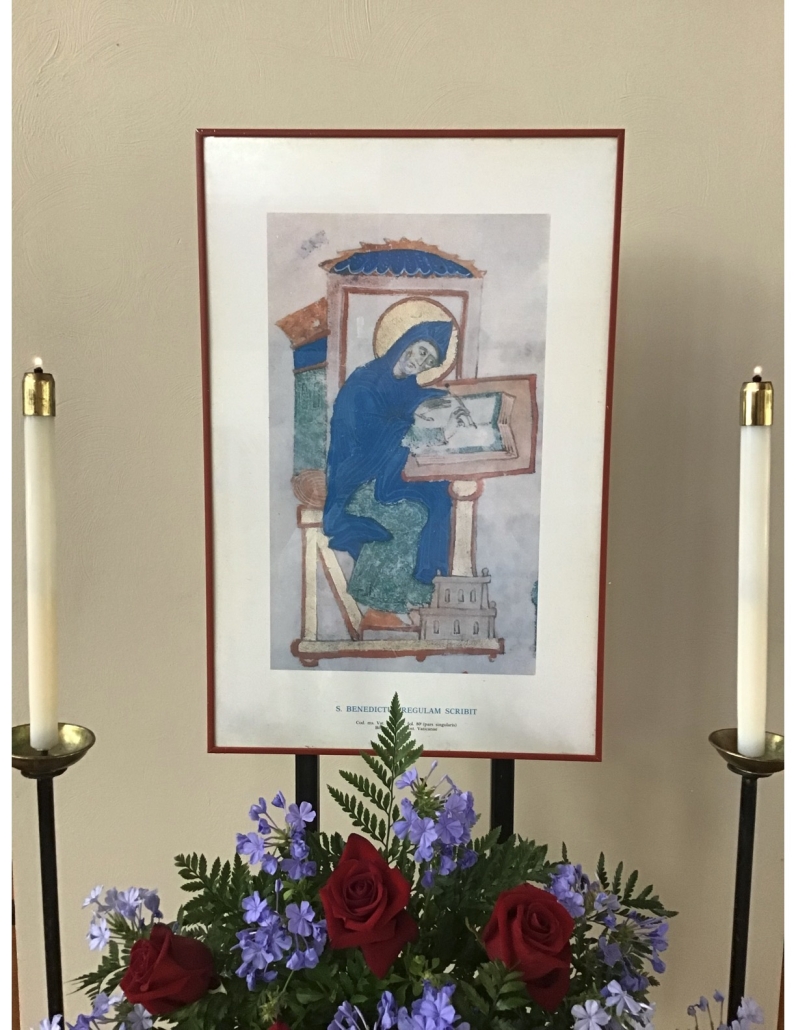
In his youth, Benedict’s love of learning led him to leave his beloved family and hometown of Nursia to study in Rome. Years later, as a young man, his love for righteousness urged him to leave the tumultuous life of the declining city of Rome. Tagging along his elderly nursemaid, he pursued a quiet rural life. Then again, his awakened love for solitude urged him to seek God more radically in austerity and so stole away from his dedicated nursemaid. He headed for the wilderness and settled in a cave by a cliff in Subiaco, where he met the monk Romanus from the monastery above the cliff. He guided Benedict in the ways of prayer and garbed him with a monastic habit and regularly lowered a food basket for his sustenance. In three years, Benedict grew in intimacy with God. Yet again, in this love, he had to abandon the austere solitary life as followers began flocking around him. He formed them into several small communities of 12 members each. Later, he established his largest community in Monte Cassino, where he finalized the Monastic Rule. It may not have been his intention, but his monastic community preserved the Christian life uninterrupted, and, as many historians observed, this greatly benefited the whole of the European world. The monastic life ordered by a balance of prayer, work, study, and community life proved to be an advantageous model for a stable society in a world torn by constant wars.
The Rule of Benedict, which opens with words from the Book of Proverbs that we have for our First Reading today, continues to guide monastic life all over the world. “Listen, my child, with the ear of your heart…” The Monastic Rule evolved over the years as Benedict grew in his monastic journey. He did not devise a collection of impositions overnight. Mainly based on the Sacred Scriptures and the earlier Rule of the Master, each stipulation reflects Benedict’s own monastic journey of seeking and loving God, which compelled him to leave not only his family but all that is familiar in favor of all that God offers. Peter’s declaration to Jesus, “Lord, we have left everything to follow you,” may well be found in the Rule of Benedict, which echoes this with the exhortation, “Prefer nothing to the love of Christ.” We may say that this is the basic framework with which Benedict built the Monastic Rule, proposing a way of life by which to live in the love of God. Benedict insists that the love of Christ must come before all else and that it must find expression in the love of others within the dynamics of community life as a school of charity and service, where there is mutual obedience and care in all humility, as described in the Acts of the Apostles. This way of life that puts into action Christ’s love benefits all, not only those within the walls of the monastery, for the Gospel of love is for all.
Now, as all systems shift with the rampaging wars, political polarizations, and global climate change, the challenge we face in this fast-evolving world remains as it has been: “How are we able to constantly love and leave behind the familiar and our personal preferences for the sake of new expressions of this love?” No matter how effective former ways are, we are compelled to embrace the new ways that God invites us into: new ways of praying, of working, of relating with one another, of using the resources that God has surrounded us with, or simply, new ways of doing things. But everything, always for the sake of loving. For only then can leaving the familiar behind and embracing the newness of life make sense.
Benedict shows us the way. He felt the urge to leave behind the familiar in pursuit of love. He had the strength and courage to do so only because he loved first. He loved God first.
Just observe how a toddler leaves the comforts of the crib, then abandons the comforts of crawling to walking, then soon discovers the joy of running and jumping, and climbing. It’s never about just abandoning the comforts of the familiar to venture into the vague emptiness. It’s always about the greater love that beckons.
May we continue to love and be open to leave and go forth. Through the intercession of St Benedict, may we truly prefer nothing to the love of Christ and be ever ready to leave. May we emerge, as always, into the newness of loving God and each one as did Benedict through all the turmoils of his time.


